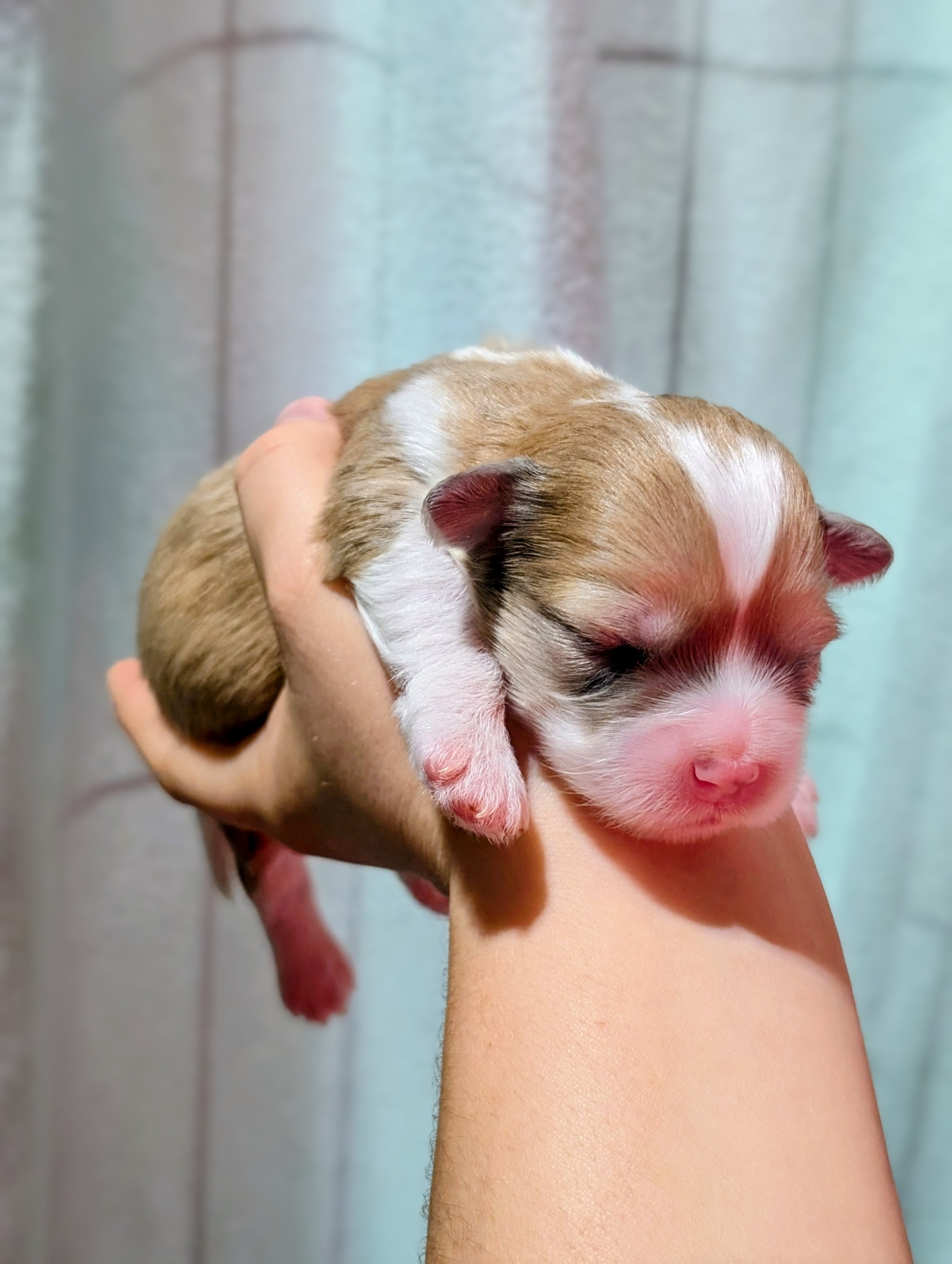
Can Doodles and “Teddy Bear” Dogs Be Ethically Bred? Health Testing Matters More Than the Label
Can doodles and teddy-bear dogs be ethically bred? Yes—but a cute name or a claim of “hybrid vigor” is no substitute for thoughtful breeding. Learn what health testing to ask for and how to verify a breeder’s results.
“Ethical doodle breeder” can be a surprisingly controversial phrase. Some people assume that crossing two breeds is automatically irresponsible. Others assume a mixed-breed puppy will automatically be healthier than either parent breed.
Neither assumption tells you enough about the dogs who produced a particular litter.
Whether you’re looking at a Cavapoo, Maltipoo, Cockapoo, Aussiechon or another fluffy companion mix, the more useful question is: What decisions did the breeder make for the health and welfare of the parents and puppies?
Crossbreeding does not erase health risks
A puppy can inherit health risks from both sides of its family. A Poodle mix still needs careful consideration of the Poodle parent’s health. A Mini Aussie × Bichon Frise still needs careful consideration of health concerns associated with Mini Aussies and Bichons.
Crossbreeding can change the odds of inheriting certain conditions, especially when the parents carry different recessive variants. But it does not make the puppies immune to inherited disease. In a large genetic study, mixed-breed dogs could carry disease variants found in purebred dogs. And a 2024 study of Cavapoos, Cockapoos and Labradoodles found limited overall health differences between those crosses and their parent breeds. That study did not evaluate every doodle or Aussiechons, but it is a good reason to avoid blanket promises that a crossbreed is healthier simply because it is a crossbreed.
The responsible approach is to evaluate the specific pairing, not rely on “hybrid vigor” as a substitute for testing.
Why can it be harder to find health-tested doodle breeders?
Established purebred parent clubs often publish breed-specific screening recommendations. A crossbreed may not have one equally clear, widely adopted checklist under its own name. That puts more responsibility on the breeder to investigate the risks on both sides and explain which tests are relevant to the dogs they are breeding.
Testing also takes time, money and planning. A basic DNA kit is relatively easy to order; an orthopedic evaluation or examination by a veterinary specialist requires more coordination. The tests must be completed on the breeding dogs at an appropriate age, before a pairing is made.
I would be cautious about claiming that health testing is “rare” across all doodle breeders—there isn’t a reliable count that would support that statement. But thoroughly tested crossbreeding programs do exist, and buyers may have to look past a cute website or a “vet checked” claim to find them.
A DNA panel is useful—but it is not the whole picture
DNA tests can identify some known inherited variants and help a breeder avoid certain risky pairings. They cannot replace every other form of screening.
Depending on the breeds involved, appropriate testing may include hip evaluations, eye examinations by a veterinary ophthalmologist, cardiac examinations, patella evaluations or other breed-specific tests. Some conditions do not have a simple DNA test. The American Kennel Club’s parent-club health guidance includes both DNA tests and physical evaluations for this reason.
A puppy’s routine veterinary exam is important, too, but it answers a different question. A puppy can look healthy at eight weeks old while a parent’s inherited risk has never been investigated.
What should you ask a breeder to show you?
Before placing a deposit, ask:
What health tests have both parents completed? Ask about the mother and the father, including a stud owned by someone else.
Why were those particular tests chosen? The answer should relate to the breeds in the pairing and any known concerns in the dogs’ family lines.
Can I see the actual results? “Health tested” should mean more than a statement on a website. Ask for the dogs’ registered names or record numbers when results are publicly available through the Orthopedic Foundation for Animals (OFA).
Were the tests completed before breeding? Timing matters, especially for screenings that must be performed or repeated at certain ages.
Were there any abnormal results, and how did they affect the breeding decision? Transparency matters more than a claim that every result is perfect.
What happens if my dog develops a health problem later? A responsible breeder should want to know, offer support and use that information when making future breeding decisions.
One detail that surprises many buyers: an OFA CHIC number means a dog completed the required screenings for its breed and made the results public. It does not, by itself, mean every result was normal. Read the results and ask the breeder to explain them.
Ethics extend beyond test results
Health testing is essential, but ethical breeding also includes selecting parents with suitable temperaments, caring well for the mother, raising puppies in a safe and enriching environment, being honest about size and coat uncertainty, matching puppies thoughtfully and remaining available to the family throughout the dog’s life.
No breeder can promise a puppy will never have a health problem. What they can do is make informed choices, show you the evidence behind those choices and take responsibility for the dogs they bring into the world.
So yes, a doodle or teddy-bear-type dog can come from a thoughtful breeding program. The fluffy coat and appealing name are not proof of one. Seek out a breeder who tests the breeding dogs, shares the results and welcomes specific questions. Your future puppy deserves that care long before they are born.
Sources and further reading
OFA Canine Health Information Center: how CHIC certification works
AKC parent-club health statements: DNA and physical screening
Donner et al. (2018): genetic disease variants in mixed-breed and purebred dogs
Bryson et al. (2024): health comparison of Cavapoos, Cockapoos and Labradoodles with parent breeds (journals.plos.org)
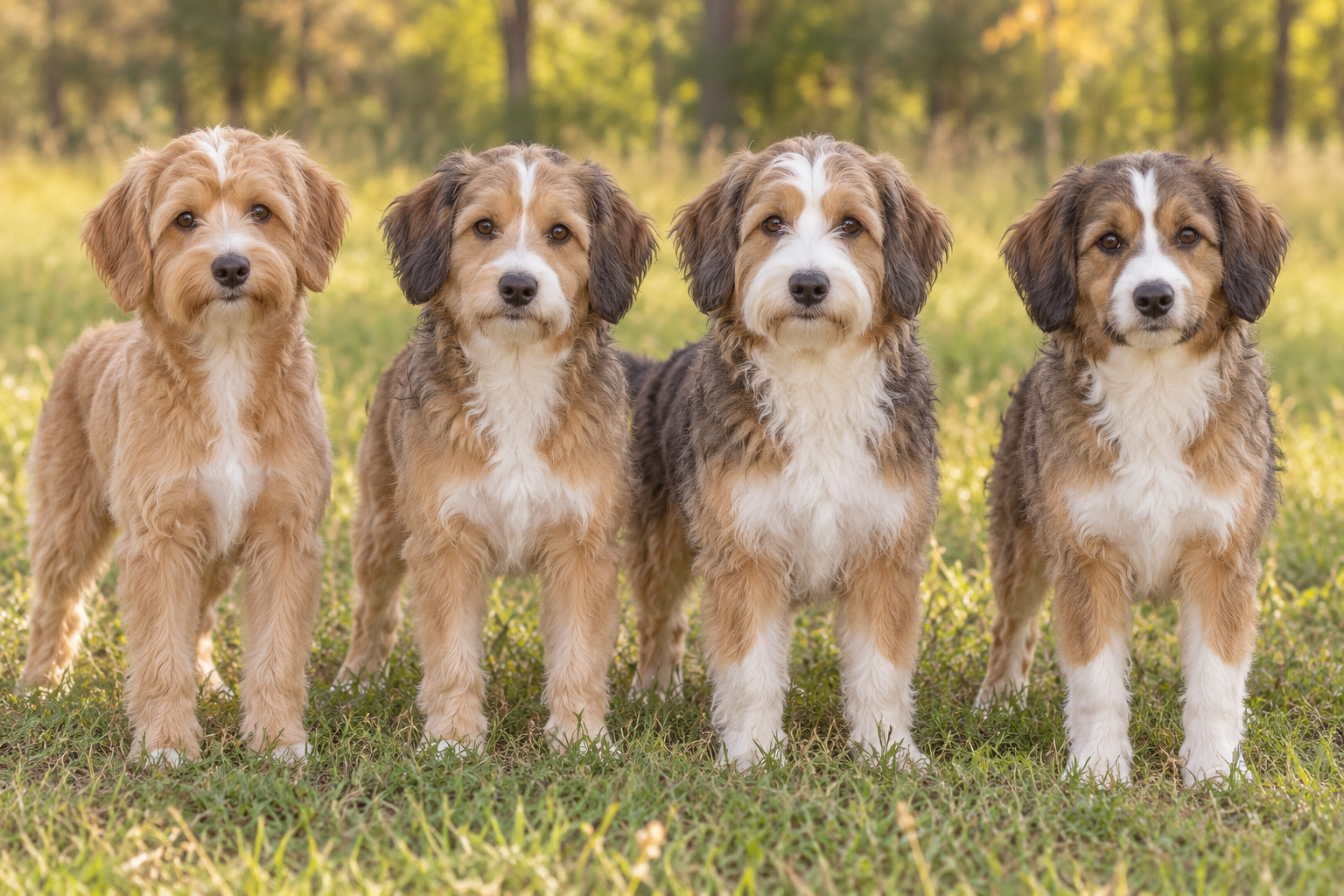
Aussiechon vs. Cavapoo, Maltipoo, Shihpoo and Other Small “Teddy Bear” Dogs
Curious how Aussiechons compare with Cavapoos, Maltipoos and other small teddy-bear dogs? Explore their personalities, grooming needs and shedding possibilities to find the right fit for your family.
If you love the fluffy teddy-bear look, the names can start to blur together. What’s the difference between an Aussiechon and a Cavapoo? Will a Maltipoo shed? Is a Cockapoo as small as the others?
These names describe crosses, not one predictable coat or personality. “Doodle” usually means a Poodle mix, while “teddy bear dog” describes a look rather than a breed. An Aussiechon is a Mini Aussie or Miniature American Shepherd crossed with a Bichon Frise—so it belongs in this conversation even though there’s no Poodle in the mix.
Here’s how some popular small companion mixes compare. Think of these as possibilities based on their parent breeds, not guarantees about every puppy.
Aussiechon: Mini Aussie × Bichon Frise
An Aussiechon may appeal to you if you want a smaller, affectionate companion who also enjoys training, walks and adventures. The Bichon brings a playful companion-dog background, while the Mini Aussie brings an active, attentive side. That combination can make for a wonderful little partner—but don’t assume a fluffy small dog will be content without things to do.
At Trailside, we describe Aussiechons as a lower-shedding option. Coat type and shedding can still vary between puppies.
Cavapoo: Cavalier King Charles Spaniel × Poodle
Cavapoos are popular with people looking for a people-oriented companion. Cavaliers are known for being gentle and adaptable, while Poodles can add an energetic, trainable side. Size and coat will depend partly on which size Poodle is used and what each puppy inherits.
Maltipoo: Maltese × Poodle
Maltipoos are often sought by families who want a very small dog that enjoys being close to its people. Their size can make them easy to bring along, but tiny dogs still need training, enrichment and careful handling. Their soft coats also need consistent care.
Shihpoo: Shih Tzu × Poodle
Shihpoos combine two small companion breeds and can have plenty of personality beneath that teddy-bear coat. Ask about the parents’ temperaments, coat care and facial structure rather than choosing based on appearance alone.
Yorkipoo: Yorkshire Terrier × Poodle
Yorkipoos may be tiny, but the Yorkshire Terrier side can bring a bold, lively outlook. If you’re imagining a quiet lapdog, spend time learning about the particular parents and puppies. A small dog can still be busy, curious and vocal!
Cockapoo: Cocker Spaniel × Poodle
Cockapoos may suit families looking for a playful companion with some spaniel enthusiasm. They can vary quite a bit in size depending on the parents. Ask about activity needs as well as grooming; those lovely coats can take real work to maintain.
Havapoo: Havanese × Poodle
Havapoos bring together two companion breeds with playful, social reputations. They’re another option to explore if you want a small dog who enjoys being involved in family life. As with the other mixes, a low-shedding coat does not mean a low-maintenance coat.
Are these dogs really non-shedding or hypoallergenic?
No mix can promise that. Puppies in the same litter may inherit different coats and shed different amounts. Research into dog coat genetics has identified genes that influence furnishings and shedding, but a mix’s name alone cannot tell you exactly what an individual puppy’s adult coat will be like.
No dog is guaranteed to be allergy-safe, either. If allergies are a major concern for your family, talk openly with the breeder and spend time around dogs with similar coats before making a commitment.
And remember: less hair on your furniture often means more work with a brush. Many fluffy coats need regular brushing and professional grooming to stay comfortable and free of mats.
How do you choose the right one?
Start with your actual day-to-day life. How much activity and training do you enjoy? Are you prepared for regular grooming? How important is adult size? If shedding matters to you, how much variation are you comfortable with?
Then ask about the specific parents and puppies. A thoughtful breeder should be able to discuss the parents’ health testing and temperaments, possible size and coat differences, and how the puppies are being raised.
At Trailside, I share updates as our Aussiechon puppies grow so families can get to know more than their markings. I want you to see how each puppy explores, interacts with people and responds to new experiences. The goal is to find a companion whose needs and personality fit your life—not just the cutest teddy-bear face.
If you’re wondering whether a Trailside Aussiechon could be right for you, I’d be happy to talk through what you’re hoping for and help you get to know our puppies or a future litter.
Further reading
American Kennel Club, “Do Hypoallergenic Dogs Exist?” https://www.akc.org/expert-advice/dog-breeds/do-hypoallergenic-dog-exist/
UC Davis Veterinary Genetics Laboratory, “Shedding+” https://vgl.ucdavis.edu/test/shedding
UC Davis Veterinary Genetics Laboratory, “Furnishings and Improper Coat” https://vgl.ucdavis.edu/test/furnishings-and-improper-coat
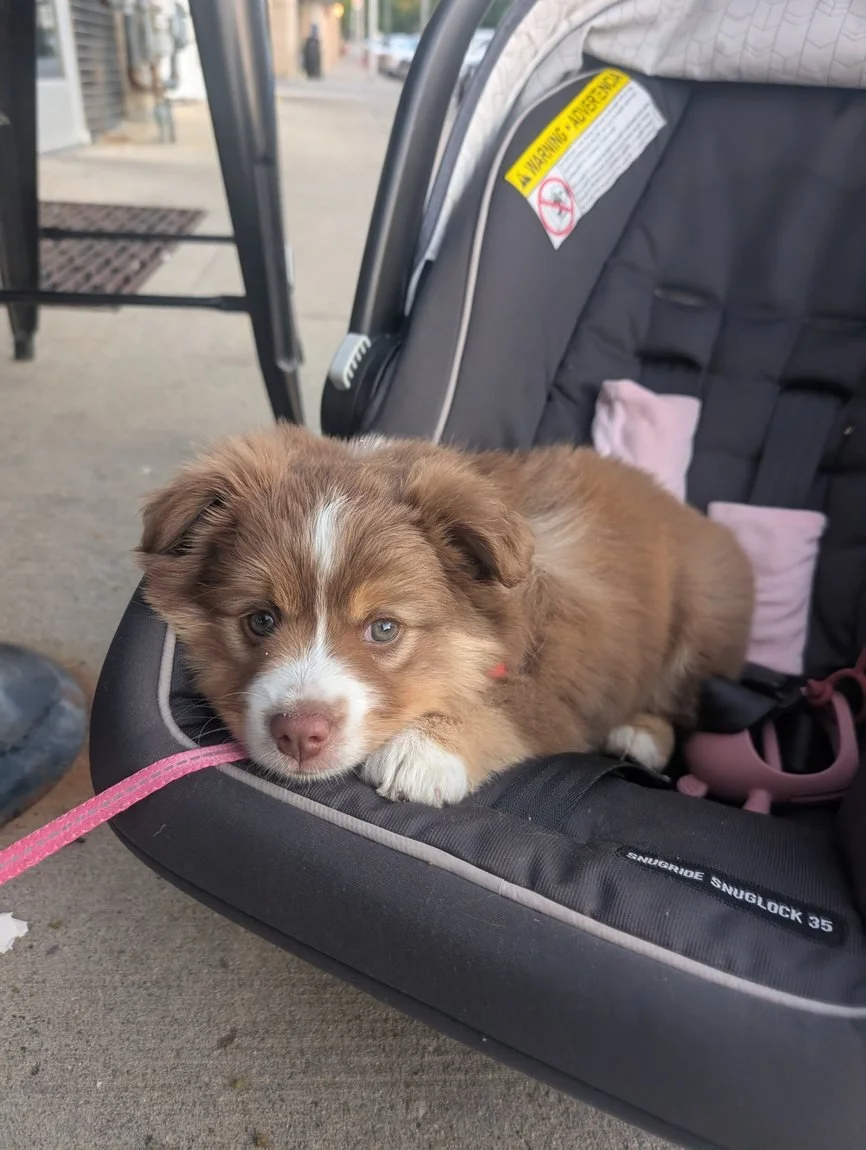
How to Socialize a Puppy Without Overwhelming Them
Puppy socialization isn't just meeting people and dogs. Learn how to socialize a puppy using positive experiences, choice, distance and recovery.
puppy socialization, puppy socialization checklist, socializing a new puppy, puppy afraid during socialization, positive puppy socialization, puppy socialization before vaccinations
If you've recently brought home a puppy, you've probably been told:
“You need to socialize them!”
That's true.
But what happens next is where puppy owners sometimes get into trouble.
Socialization can quickly turn into a race:
Meet people.
Meet children.
Meet dogs.
Visit stores.
Hear motorcycles.
Walk on strange surfaces.
See umbrellas.
Meet someone with a beard.
Find a person wearing a hat.
Check. Check. Check.
But there's a problem.
Exposure isn't automatically socialization.
What your puppy learns from the experience matters.
At Trailside Mini Aussies & Aussiechons in Missouri, thoughtful socialization is an important part of how we approach puppy development.
And one of the questions I want owners to keep asking is:
What is my puppy learning from this experience?
What Does Puppy Socialization Actually Mean?
Puppy socialization involves helping puppies develop appropriate responses to the kinds of people, animals, environments, handling, sounds, surfaces, objects, and situations they'll encounter in life.
Early development is an important period for these experiences.
But more isn't automatically better.
A puppy who has ten thoughtful, manageable experiences isn't necessarily behind a puppy who was dragged through fifty overwhelming ones.
Quality matters.
Your Puppy Doesn't Have to Love Everything
This is important.
The goal of socialization isn't creating a dog who desperately wants to greet every human and dog they see.
Neutrality is incredibly useful.
Imagine your puppy sees another dog across the street.
They look.
Then they look back at you.
Then they continue sniffing.
Nothing exciting happens.
That's a successful experience.
Your puppy just practiced existing around another dog without needing to interact.
The same applies to people, bicycles, children, vehicles, livestock, shopping carts, and countless other pieces of normal life.
Positive is good.
Neutral is good.
Overwhelmed isn't the goal.
How Can I Tell Whether My Puppy Is Comfortable?
Look at the entire dog and the context rather than relying on one isolated signal.
Does your puppy willingly explore?
Can they sniff?
Can they eat?
Can they move normally?
Can they disengage from whatever they're observing?
Do they check in with you?
If startled, can they recover?
Conversely, a puppy who is desperately trying to escape, repeatedly freezing, unable to engage, or becoming increasingly distressed probably needs something about the situation to change.
Often the simplest change is:
More distance.
Don't Lure Your Frightened Puppy Toward the Scary Thing
Food can be an incredibly useful part of socialization and behavior work.
But there's an important difference between using food to create positive associations and using food to convince a frightened puppy to move closer than they otherwise would.
Imagine your puppy is afraid of a large garbage can.
You hold chicken directly beside the garbage can.
Your puppy wants the chicken badly enough to creep forward.
They reach the food—and suddenly realize they're much closer to the scary object than they wanted to be.
Instead, give your puppy room to think.
They can look.
Approach.
Retreat.
Sniff.
Check in with you.
Approach again.
Retreat isn't failure.
The goal isn't physical proximity.
The goal is helping your puppy successfully process something unfamiliar.
Confidence Doesn't Mean “Never Afraid”
A confident dog can still startle.
They can still hesitate.
They can still decide something is weird.
What I care about tremendously is recovery.
Can your puppy encounter something surprising, gather information, and return to normal behavior?
That's a much more realistic goal than trying to create a dog who never experiences fear.
Does My Puppy Need to Meet Lots of People?
Your puppy should have appropriate experiences with different kinds of humans, but that doesn't mean every human needs to physically interact with them.
Your puppy can observe people.
They can watch a person using a cane.
See a child running.
Notice a person wearing a large hat.
Hear people laughing.
Walk past someone.
And sometimes, yes, greet someone.
But seeing a human doesn't need to become an automatic cue to rush over and say hello.
That lesson can make adult life considerably easier.
What About Children?
Children deserve special consideration because they may move, sound, and interact differently than adults.
Supervise puppy-child interactions.
Don't allow children to chase a puppy who is trying to move away.
Avoid expecting puppies to simply tolerate grabbing, hugging, climbing, or invasive handling.
Teach the child too.
If puppy moves away, let them.
If puppy is sleeping, leave them alone.
If puppy has food or a chew, don't take it.
Gentle, mutually comfortable interactions benefit everyone.
Does My Puppy Need to Play With Other Dogs?
Dog socialization isn't synonymous with dog play.
Carefully selected interactions with appropriate dogs can be valuable.
But your puppy doesn't need to wrestle with every dog they see.
Learning to calmly exist around dogs is also socialization.
Choose social partners thoughtfully rather than assuming every friendly stranger's dog is an appropriate puppy teacher.
Can I Socialize My Puppy Before They're Fully Vaccinated?
This is an area where owners often receive confusing advice.
Behavioral development doesn't stop while a puppy completes their vaccine series.
At the same time, infectious-disease risk is real and varies geographically.
Veterinary behavior guidance supports beginning appropriate socialization during the early developmental period while taking sensible disease precautions rather than universally isolating puppies until every vaccine is complete.
Talk with your veterinarian about disease risk in your area.
Safer socialization doesn't have to mean putting your puppy on the floor of a high-traffic dog area.
You can carry a young puppy through an environment when appropriate, visit controlled locations, spend time at trusted homes, observe the world from the car, use clean/private outdoor areas, and carefully choose interactions with healthy dogs whose vaccination status you know.
The goal is balancing behavioral development with infectious-disease safety, not pretending either concern doesn't exist.
Socialize for the Life Your Puppy Will Actually Live
This is one of my favorite ways to think about socialization.
Don't just follow a generic checklist.
Ask:
What will MY dog need to comfortably handle as an adult?
If you live on a farm, that might include livestock, equipment, gates, trailers, gravel, mud, and machinery.
If you live in a city, it may include elevators, traffic, crowds, delivery carts, buses, and narrow sidewalks.
If you travel frequently, prioritize cars, luggage, new environments, and appropriate public spaces.
If your dog will regularly attend children's sporting events, that environment matters.
If your dog will be professionally groomed throughout their life, grooming is socialization too.
Prepare your puppy for their future—not someone else's checklist.
Keep Socialization Sessions Short
You don't need to spend an entire afternoon somewhere to make it valuable.
Sometimes five successful minutes are enough.
I'd rather leave while a puppy is comfortable and successful than remain until they're exhausted or overwhelmed simply because we planned a thirty-minute outing.
Your plan is less important than your puppy's experience.
What If We Have a Bad Socialization Experience?
You haven't ruined your puppy.
Something unexpected will eventually happen.
A dog will bark.
Something will fall.
A child will shriek.
A truck will make a strange noise.
Your puppy may become frightened.
Help them create distance and recover.
Future carefully managed experiences can help rebuild positive or neutral associations.
If fear persists, worsens, or begins generalizing to other situations, seek professional help early.
Socialization Is About Building a Worldview
Ultimately, I don't care whether your puppy checked every box on a socialization spreadsheet.
I care whether they're beginning to learn:
I can explore.
I can observe.
I don't have to interact with everything.
I can move away when I need to.
My human listens.
Unexpected things happen—and I can recover.
That's the foundation we're after.
Want a Roadmap for Your Puppy's First Month?
Socialization is only one part of bringing home a puppy.
My Bringing Puppy Home: Your Positive-Reinforcement Guide to the First Month Together walks new puppy owners through socialization alongside potty training, crate training, biting, sleep, fear and startle, alone-time skills, enrichment, handling, resource guarding prevention, and foundational training.
GET THE BRINGING PUPPY HOME GUIDE
You can also read:
Bringing Home a Mini Aussie Puppy →
Bringing Home an Aussiechon Puppy →
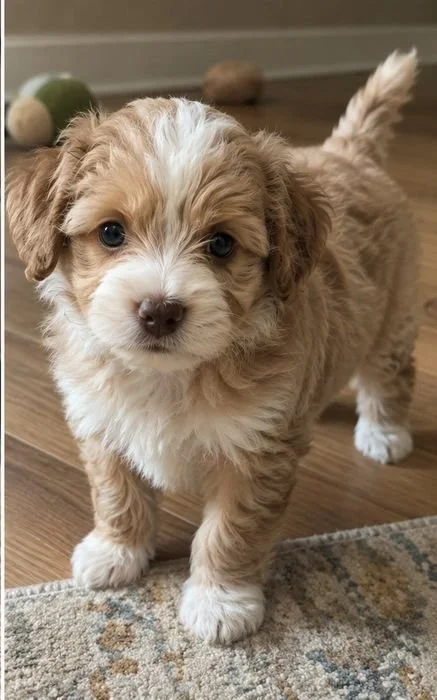
Aussiechon Grooming Guide: Brushing, Coat Care & Puppy Grooming
Learn about Aussiechon grooming, brushing, coat care, puppy grooming, nail handling and how to teach your Aussiechon to comfortably participate in grooming.
how to groom an Aussiechon, Aussiechon coat, Aussiechon puppy grooming, Aussiechon brushing, Aussiechon haircut, Aussiechon coat care
If you're considering an Aussiechon because you've fallen in love with that fluffy teddy-bear appearance, there's something important to know:
The fluff requires maintenance.
An Aussiechon is a cross involving an Australian Shepherd-type dog and a Bichon Frise. Because Aussiechons are crosses rather than a standardized breed, coat type can vary between individual dogs.
That means there isn't one universal Aussiechon grooming schedule that applies perfectly to every dog.
But you should expect ongoing coat care.
At Trailside Mini Aussies & Aussiechons in Missouri, I think grooming preparation should begin long before a puppy actually needs an elaborate haircut.
Because grooming isn't only about maintaining the coat.
It's a behavior skill.
What Kind of Coat Does an Aussiechon Have?
Aussiechon coats can vary depending on the traits inherited from their parents.
Some puppies may develop coats that are curlier, wavier, straighter, denser, softer, or otherwise different from their littermates.
This is one reason I'd be cautious about anyone promising exactly what every Aussiechon coat will look like as an adult.
Your individual dog's coat determines the care it needs.
Regardless, regular brushing and professional grooming may become important parts of maintaining an Aussiechon comfortably.
Start Grooming Your Aussiechon as a Puppy
One of the biggest grooming mistakes is waiting until the coat desperately needs attention.
Imagine your puppy has never experienced brushing, clippers, nail care, or prolonged handling.
Then suddenly they're placed on a grooming table and expected to tolerate all of it.
That's a huge request.
Instead, make grooming part of normal puppy life.
But keep it tiny.
Touch paw → treat.
Hold paw briefly → treat.
Brush once → treat.
Touch ear → treat.
Handle muzzle → treat.
Introduce nail tool → treat.
Done.
Tomorrow you can practice again.
You Don't Need to Finish the Job
This is one of my favorite concepts in cooperative care.
Training sessions don't always need to accomplish the actual grooming task.
If your goal today is teaching your puppy that a brush touching their body predicts something wonderful, you don't need to brush their entire coat.
Training and necessary maintenance sometimes overlap.
But they aren't always the same thing.
When possible, practice before you urgently need to complete the procedure.
What If My Aussiechon Bites the Brush?
First, don't immediately label them difficult.
Ask why.
Is the puppy trying to play?
Is brushing uncomfortable?
Are you pulling through a tangle?
Has the session gone on too long?
Is puppy overtired?
Are they trying to communicate that they need a break?
Behavior gives you information.
If your puppy is struggling, make the exercise easier.
How Often Should an Aussiechon Be Professionally Groomed?
The appropriate grooming interval depends on your dog's individual coat, haircut, lifestyle, home maintenance, and groomer's recommendations.
Instead of relying on one universal number from the internet, establish a relationship with a professional groomer who can evaluate your dog's actual coat.
Ask what home brushing tools they recommend and which areas of your individual dog tend to mat first.
Your groomer can become an important part of your dog's care team.
Don't Forget Nails, Ears, Feet & Teeth
Coat care gets most of the attention because it's visible.
But puppy grooming preparation should also include gentle exposure to paw handling, nail tools, ear examination, mouth handling, face handling, standing on grooming surfaces, and the sights and sounds associated with grooming.
Again, don't introduce everything at maximum intensity.
Build familiarity gradually.
Can Aussiechons Be Hypoallergenic?
Be careful with this claim.
No dog should be guaranteed to an allergy-sensitive family as universally “hypoallergenic,” particularly a cross whose coat characteristics can vary.
If allergies are a significant concern, discuss them with an appropriate medical professional and spend time around relevant adult dogs rather than assuming a particular breed mix guarantees a reaction-free household.
Make Grooming a Conversation
I don't want my ultimate grooming goal to be:
“My dog learned there's nothing they can do about it.”
Whenever practical, I'd rather build:
“My dog understands what is happening, feels safe, and knows how to participate.”
That takes longer initially.
But you're not training your puppy for one grooming appointment.
You're preparing them for years of care.
Bringing Home an Aussiechon Puppy?
My Bringing Puppy Home guide walks through cooperative care alongside potty training, crates, puppy biting, sleep, socialization, fear, alone time, enrichment, and your first month together.
GET THE BRINGING PUPPY HOME GUIDE
And read:
[Bringing Home an Aussiechon Puppy →]
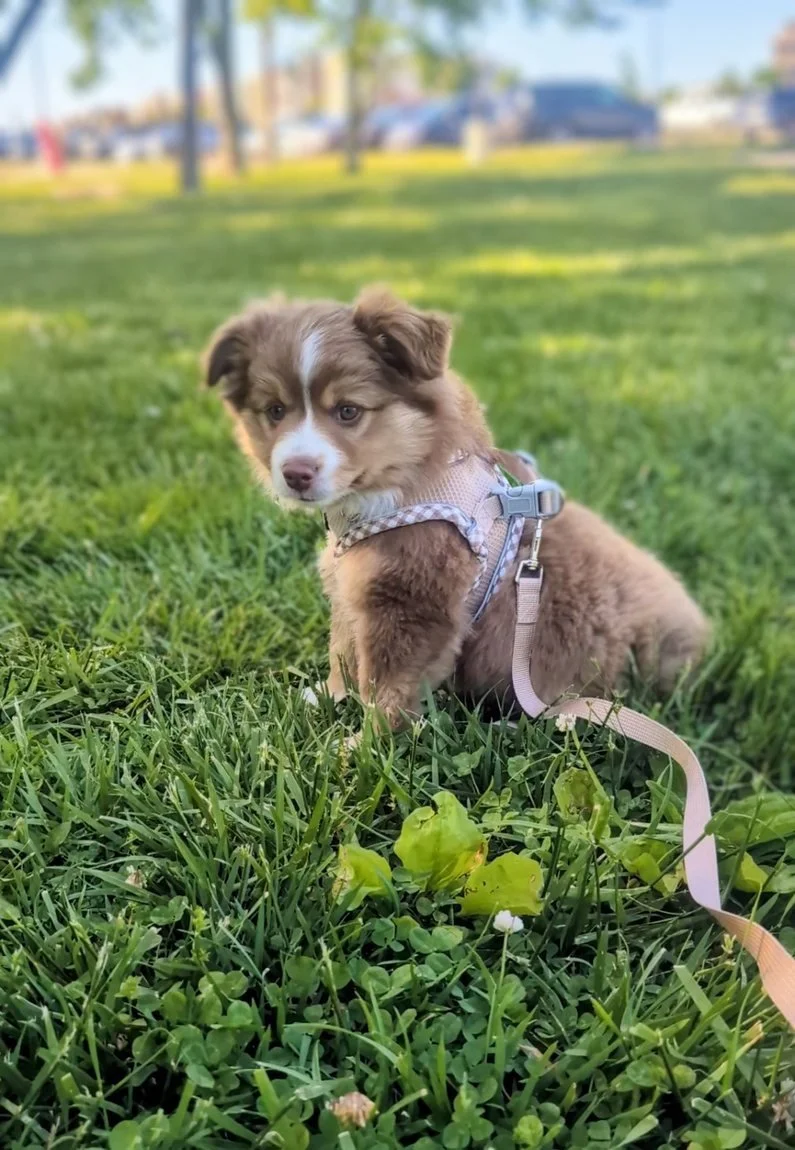
How to Potty Train a Mini Aussie Puppy: Step-by-Step Guide
Learn how to potty train a Mini Aussie or Miniature American Shepherd puppy using a simple schedule, supervision, positive reinforcement and management.
Mini Aussie potty training, Miniature American Shepherd potty training, Mini Aussie puppy accidents, Mini Aussie puppy potty schedule
Potty training a Mini Aussie puppy comes down to four things:
Frequent opportunities. Good supervision. Smart management. Reinforcement for getting it right.
That's the short answer.
Your puppy doesn't need to understand why humans care deeply about which side of the door they pee on.
They simply need enough repetition for one location to become the obvious choice.
At Trailside Mini Aussies & Aussiechons in Missouri, our puppies begin developing potty foundations before they leave us. But going home changes the environment, schedule, surface, smells, and people—so families should expect to continue teaching the skill.
How Often Should I Take My Mini Aussie Puppy Outside?
Rather than relying exclusively on a timer, learn the situations that commonly trigger elimination.
Take your puppy out:
immediately after waking
after eating or drinking
after active play
after leaving the crate or pen
before bedtime
whenever you notice your puppy's individual pre-potty behavior
Very young puppies generally need more frequent opportunities than older puppies.
Excitement can also change the schedule.
A puppy who normally lasts longer may suddenly need to pee after ten minutes of wrestling around the living room.
Go outside with your puppy.
Opening the door and assuming they went doesn't tell you anything.
Your puppy may spend five minutes eating a leaf, come inside, and immediately pee on your floor.
Go with them so you know what happened.
What Should I Do When My Puppy Goes Potty Outside?
Reinforce them.
I prefer to let the puppy finish eliminating before delivering the reward.
You can also add a potty cue as the puppy develops a predictable pattern.
And here's a useful detail:
Don't make every successful potty trip immediately end outdoor time.
If peeing consistently causes you to say “Great!” and immediately march the puppy back into the boring house, some puppies can become reluctant to eliminate quickly.
Sometimes potty can be followed by another minute of sniffing or exploring.
What Should I Do When My Mini Aussie Has an Accident?
Clean it.
That's it.
No lecture.
No rubbing their nose in it.
No dragging them over to inspect their work.
No punishment after the fact.
Then ask yourself:
What management step did I miss?
Maybe puppy had too much freedom.
Maybe the interval was too long.
Maybe you missed a signal.
Maybe they had just played or eaten.
Maybe they weren't actually empty when you brought them inside.
An accident is useful information about your current system.
Adjust accordingly.
Why Enzymatic Cleaner Matters
Dogs experience their environment through smell in ways we don't.
A spot that smells clean to you may still contain odor from previous elimination.
Use an enzymatic pet-odor cleaner on accidents according to its directions.
Nature's Miracle happens to be one of my personal favorites.
Thorough cleaning helps the wrong bathroom stop smelling like a bathroom.
Meanwhile, keeping the outdoor potty location relatively consistent can make the correct choice easier to recognize.
How Much Freedom Should a Puppy Have?
Less than most new puppy owners think.
If you're actively supervising, puppy can be with you.
If you can't supervise, use a crate, pen, gated puppy-safe area, or another appropriate management setup.
As potty reliability improves, gradually increase freedom.
Don't give your puppy the entire house and then spend your day trying to catch mistakes.
Prevention is part of training.
My Mini Aussie Was Potty Trained and Suddenly Had an Accident. What Happened?
One accident doesn't mean your puppy has forgotten everything.
Changes in routine, excitement, access to new areas, longer intervals, distraction, stress, or developmental changes can all affect behavior.
Go back to tighter management temporarily.
If a previously reliable puppy suddenly begins having frequent accidents, urinating unusually often, straining, or showing other physical changes, contact your veterinarian.
Behavior can have medical causes.
How Long Does It Take to Potty Train a Mini Aussie?
There isn't a universal deadline.
Your puppy's age, previous experience, schedule, environment, individual development, and your consistency all matter.
Instead of asking whether your puppy is officially “potty trained,” watch the trend.
Are accidents becoming less frequent?
Is your puppy beginning to head toward the door or potty area?
Can they comfortably wait longer?
Are they reliable in increasingly larger areas of the house?
That's progress.
Want the Complete New-Puppy Plan?
Potty training becomes much easier when it's part of a larger routine involving sleep, crates, supervision, play, training, and appropriate freedom.
That's why I created Bringing Puppy Home: Your Positive-Reinforcement Guide to the First Month Together.
You can also read:
Bringing Home a Mini Aussie Puppy: First-Week Guide →
Why Is My Mini Aussie Puppy Biting? →
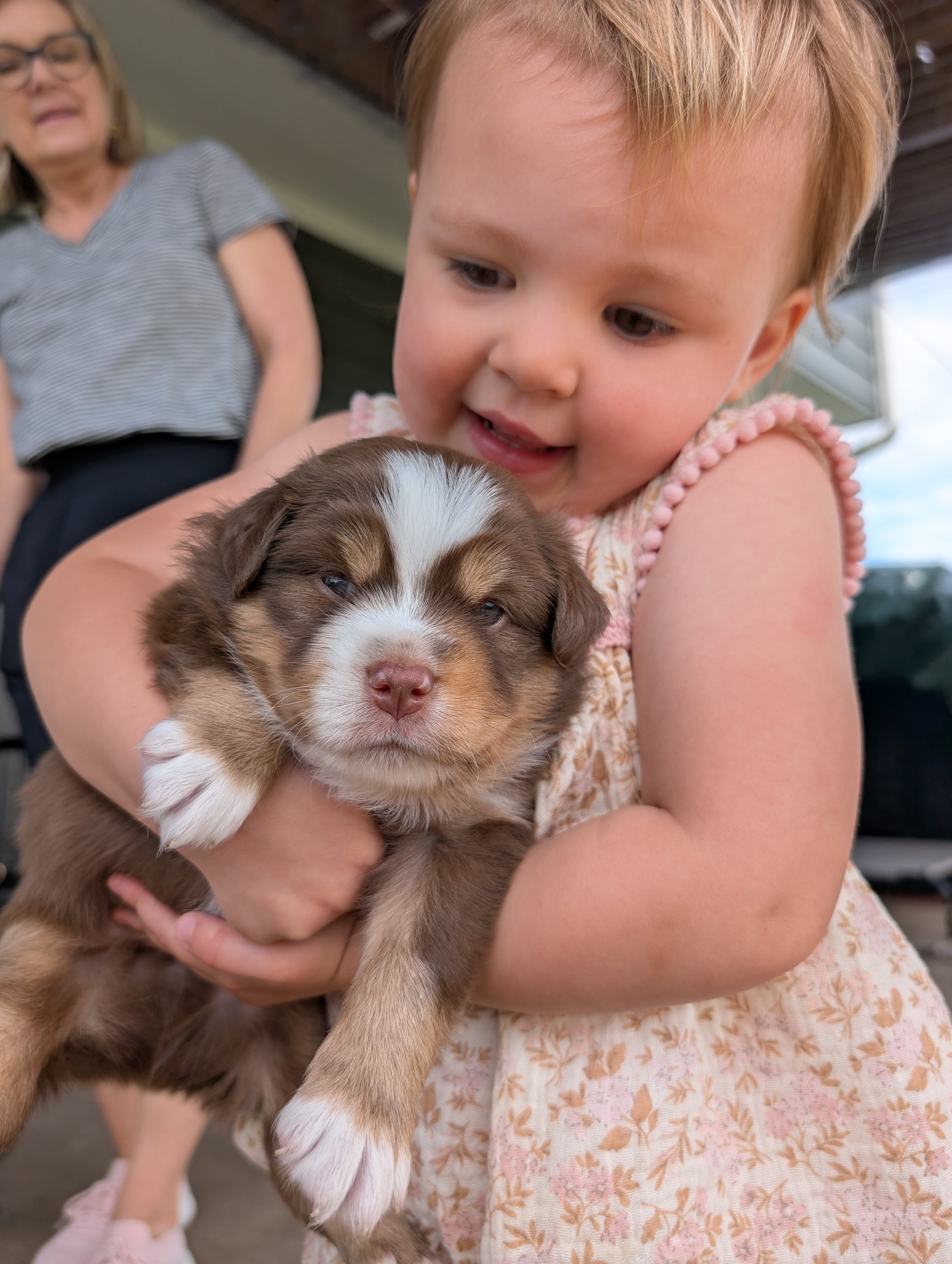
How to Stop Mini Aussie Puppy Biting: Why They Nip & What to Do
Is your Mini Aussie puppy biting your hands, feet or ankles? Learn why Miniature American Shepherd puppies nip and what to do using positive reinforcement.
how to stop Mini Aussie puppy biting, Mini Aussie biting ankles, Mini Aussie puppy nipping, Miniature American Shepherd puppy biting, Miniature American Shepherd nipping, herding puppy biting
If your Mini Aussie puppy spends part of every day attached to your pants, ankles, hands, shoelaces, or sleeves, you are not alone.
Puppies bite.
And when you combine normal puppy mouthing with an intelligent, active herding dog who may find movement particularly exciting, you can end up with an impressive little land shark.
At Trailside Mini Aussies & Aussiechons in Missouri, puppy biting is something I want families to understand rather than simply suppress.
Because the most useful question isn't:
“How do I make my Mini Aussie stop biting?”
It's:
“Why is my puppy biting right now?”
A puppy biting because they're exhausted needs a different response than a puppy biting because they want to play.
Let's figure out which puppy you have.
Is Biting Normal for a Mini Aussie Puppy?
Yes. Biting and mouthing are normal puppy behaviors.
Puppies interact with their environment using their mouths. They play with their mouths, investigate objects with their mouths, chew during teething, and use mouthing during interactions.
Miniature American Shepherds—often called Mini Aussies—also come from a herding background.
Research into canine genetics supports a biological contribution to breed-related behavioral patterns, including components of herding and chase-related behavior.
That doesn't mean:
Mini Aussie + moving ankle = genetically destined to bite.
It does mean that movement can be especially interesting to some herding puppies.
The important part is figuring out what is triggering the biting you're seeing.
Reason #1: Your Mini Aussie Puppy Wants to Play
This is probably the easiest one to recognize.
Your puppy grabs your sleeve.
You pull it away.
Puppy chases it.
You push puppy away.
Puppy launches back at you.
Congratulations—you may have accidentally invented an incredible game.
Instead, try moving the interaction onto an appropriate toy.
Tug toys can be particularly useful because they allow your puppy to bite, pull, chase, and interact with you without using your body as the toy.
The lesson becomes:
Want to bite and tug? Great. Here's where we do it.
Reason #2: Your Puppy Is Overtired
This one catches a lot of puppy owners off guard.
An overtired puppy doesn't necessarily look sleepy.
Sometimes an overtired puppy looks completely unhinged.
If your Mini Aussie has been awake for a while and suddenly begins sprinting, grabbing clothes, biting harder, barking, attacking everything that moves, and losing their ability to focus, more exercise may not be the answer.
Try:
Potty → quiet environment → appropriate chew → rest.
If your puppy magically transforms back into a reasonable creature after sleeping, you've learned something useful about their biting.
Reason #3: Movement Is Triggering Chasing and Nipping
Does your puppy ignore your ankles until you start walking?
Do running children immediately get their attention?
Do flowing pants or shoelaces become irresistible?
Movement may be part of the trigger.
For these puppies, I like providing appropriate opportunities to chase and grab toys while separately reinforcing calm behavior and disengagement around human movement.
Tug, retrieve games, and toy-chasing games can all be useful.
A flirt pole can also be a practical enrichment tool for some dogs. With a growing puppy, I keep movements low and sweeping rather than encouraging repeated high jumps or abrupt aerial turns.
And I keep sessions short.
A note about flirt poles
There is evidence supporting genetic and breed-related influences on herding/chase behavior and evidence that toys can successfully elicit play.
However, I have not found controlled evidence demonstrating that flirt-pole play specifically prevents puppy nipping.
I use it as an enrichment and redirection option—not a scientifically proven treatment for biting.
That's an important distinction.
Reason #4: Your Puppy Is Teething
Sometimes your puppy wants to chew because their mouth needs to chew.
Give them appropriate options.
Rotate puppy-safe chews and food toys rather than expecting them to simply stop using their mouth.
Supervise edible chews and remove anything that becomes small enough to swallow or otherwise unsafe.
Reason #5: Your Puppy Is Telling You to Stop
This category deserves special attention.
If your puppy repeatedly mouths or bites when you brush them, restrain them, touch their feet, pick them up, or perform another handling activity, don't automatically assume they're being naughty.
They may be communicating discomfort.
Stop and reassess.
Can you break the activity into a much smaller step?
Instead of restraining a paw for a complete nail trim, perhaps today's training is:
Touch paw → treat → done.
Listening to early communication can prevent us from creating bigger handling conflicts later.
Reason #6: You Have Something Your Puppy Wants
Sometimes the problem isn't really biting.
It's frustration.
Maybe your puppy wants the food in your hand.
Maybe you're holding their toy.
Maybe you're preventing them from reaching something.
Teaching skills such as waiting, hand targeting, trading, dropping objects, and settling gives your puppy alternative behaviors.
What Should You NOT Do When Your Mini Aussie Puppy Bites?
Avoid turning biting into a physical battle.
Repeatedly grabbing your puppy's muzzle, pinning them down, intimidating them, or trying to establish that you're “alpha” doesn't address why the behavior is occurring.
I would much rather identify the function of the biting, manage the environment, reinforce useful alternative behaviors, and provide appropriate outlets.
Also be careful about accidentally making yourself more exciting.
Yelping and rapidly pulling your hands away may interrupt some puppies.
For others?
You've just become a squeaky toy.
Pay attention to your puppy's response, rather than assuming one technique works universally.
The Mini Aussie Puppy Biting Checklist
When the teeth come out, run through this:
Does puppy need to potty?
How long has puppy been awake?
Is puppy trying to initiate play?
Did human movement trigger the behavior?
Does puppy need something appropriate to chew?
Is puppy frustrated?
Is puppy communicating discomfort with what I'm doing?
Once you know why, your response becomes much clearer.
When Does Mini Aussie Puppy Biting Become Concerning?
Normal puppy mouthing can look dramatic.
However, context matters.
If biting is associated with significant fear, persistent resource guarding, unusual body stiffness, repeated aggressive behavior, pain, or a sudden significant behavior change, talk with your veterinarian and an appropriately qualified behavior professional.
Don't wait until a small concern becomes a serious one.
Need More Help With Your New Mini Aussie?
Puppy biting is only one piece of the first-month puzzle.
My Bringing Puppy Home: Your Positive-Reinforcement Guide to the First Month Together covers biting, potty training, crates, sleep, socialization, fear, alone time, enrichment, cooperative care, resource guarding prevention, and what to actually prioritize when your puppy comes home.
GET THE BRINGING PUPPY HOME GUIDE
And if you're preparing to bring home a Miniature American Shepherd puppy, start here:
READ: Bringing Home a Mini Aussie Puppy →
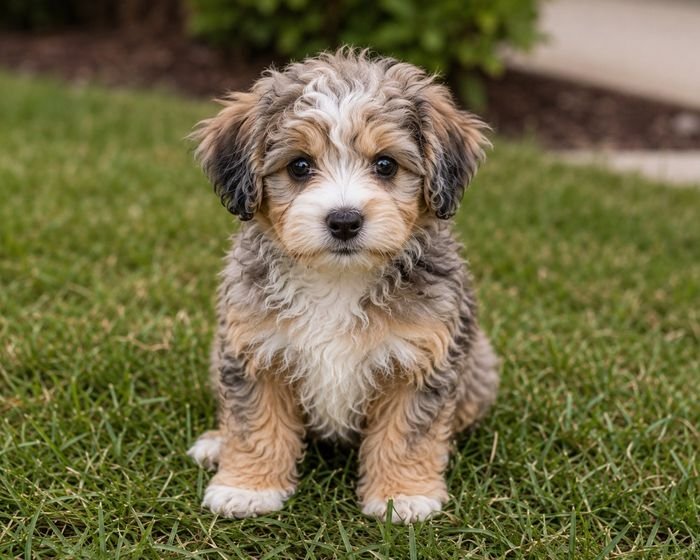
Bringing Home an Aussiechon Puppy: First-Week Training & Care Guide
Bringing home an Aussiechon puppy? Learn what to expect with potty training, crate training, grooming, biting, sleep, socialization and your puppy's first week.
Aussiechon puppy first week, Aussiechon puppy training, Aussiechon potty training, Aussiechon crate training, Aussiechon puppy biting, Aussiechon grooming, Aussiechon socialization, Aussiechon puppies Missouri
You're bringing home an Aussiechon puppy.
Prepare yourself for an unreasonable amount of fluff.
Underneath that adorable teddy-bear exterior, however, is still a puppy—and often a clever, social little one.
An Aussiechon is a cross between an Australian Shepherd-type dog and a Bichon Frise. Because Aussiechons are a cross rather than a standardized breed, individual puppies can vary in size, coat, temperament, energy level, and which characteristics they inherit from either side of their family.
That's important.
Rather than deciding what your Aussiechon should be like based entirely on their breed mix, get to know the puppy actually living in front of you.
At Trailside Mini Aussies & Aussiechons in Missouri, we raise our puppies with an emphasis on early socialization, enrichment, handling, and positive-reinforcement foundations. But even a thoughtfully raised puppy experiences an enormous transition when they leave their breeder and move into their new home.
Here's what I'd prioritize during those first few weeks.
What Should You Do the First Day With an Aussiechon Puppy?
Not very much.
Really.
Your puppy has left the environment they knew, including familiar people, puppies, smells, sounds, sleeping arrangements, and routines.
Coming home is already a major experience.
Give your puppy time to explore their new environment without immediately filling the house with visitors.
Show them their potty area.
Introduce their sleeping area.
Let them eat, play, investigate, and sleep.
Spend time together without expecting much.
You're beginning a relationship—not conducting an orientation seminar.
Establish a Predictable Puppy Routine
Puppies generally benefit from predictable rhythms.
That doesn't mean breakfast must occur at exactly 7:02 every morning.
It means your puppy begins learning what generally happens next.
A simple rhythm might look like:
WAKE → POTTY → EAT / PLAY / TRAIN → POTTY → REST
Your puppy needs opportunities to play and explore, but they also need plenty of sleep.
An overtired puppy may become increasingly mouthy, wild, frustrated, zoomy, or unable to settle.
If your adorable Aussiechon transforms into a tiny demon every evening, don't automatically assume they need another thirty minutes of exercise.
They might need a potty break and a nap.
Potty Training an Aussiechon Puppy
One of the first questions new owners have is: How do I potty train my Aussiechon?
The answer is mostly management, supervision, and repetition.
Take your puppy to their designated potty area frequently, especially after waking, eating, drinking, active play, and confinement.
Go with them.
When your puppy eliminates in the correct location, reinforce them after they finish.
When an accident happens indoors, don't punish your puppy.
Clean it thoroughly with an enzymatic cleaner and troubleshoot.
Were they given too much freedom?
Did too much time pass between potty trips?
Were they playing and suddenly needed to go?
Did you miss their normal signals?
Your puppy isn't having an accident because they're stubborn or angry with you.
They're learning.
Crate Training an Aussiechon Puppy
The crate shouldn't begin as a place where your puppy suddenly discovers they're trapped.
Create positive associations first.
Feed meals in or around the crate. Toss treats inside. Offer special chews or food-stuffable toys there. Allow your puppy to voluntarily enter and leave.
Gradually introduce the closed door and longer duration as your puppy becomes comfortable.
You can also teach a clear release cue so your puppy understands when they're being asked to remain somewhere and when they're free to leave.
But there's another piece that's especially important for a puppy who loves being close to their humans:
Crate training and alone-time training are different skills.
A puppy can happily sleep in their crate beside you and still struggle when you leave.
Which brings us to something worth starting early.
Teach Your Aussiechon Puppy How to Be Alone
It's incredibly tempting to spend every waking moment with a new puppy.
They're tiny.
They're adorable.
They want to be with you.
You want to be with them.
But eventually you need to shower.
Or leave the house.
Or cook dinner.
Or simply exist in another room without having a fluffy shadow attached to your ankle.
Comfortable independence is something we can practice.
Start incredibly small.
Let your puppy work on a food toy in their pen while you're nearby.
Let them nap in their crate while you move around the house.
Step briefly out of sight and return.
Build gradually.
We're not trying to manufacture distress so your puppy “learns” nobody is coming.
We're creating a history that says:
My person leaves sometimes. I'm safe. And my person comes back.
If your puppy repeatedly escalates into significant distress, don't simply keep making the separation longer. Make the exercise easier and seek qualified help when necessary.
Aussiechon Grooming Should Start Immediately
Don't let the teddy-bear coat fool you into thinking grooming is a problem for Future You.
Depending on the coat an individual Aussiechon inherits, grooming requirements can vary, but regular coat care is something owners should expect.
The easiest time to teach grooming skills is before you desperately need them.
Keep practice sessions tiny.
Touch a paw → treat.
Briefly hold the paw → treat.
Brush once → treat.
Handle an ear → treat.
Touch around the muzzle → treat.
Introduce a nail tool → treat.
And then stop.
You don't need to brush your puppy for twenty minutes to make grooming practice worthwhile.
A few comfortable repetitions can be more useful than forcing a puppy through a complete grooming session.
The long-term goal isn't merely a dog who gives up and tolerates grooming.
Whenever practical, I want a dog who understands what's happening and comfortably participates.
Why Is My Aussiechon Puppy Biting So Much?
Because you brought home a puppy.
Unfortunately, the teddy-bear appearance does not eliminate the teeth.
Puppies may bite because they're playing, teething, frustrated, overstimulated, tired, uncomfortable with handling, or trying to interact with you.
Before asking:
“How do I make my Aussiechon stop biting?”
Ask:
“Why is my puppy biting right now?”
If your puppy is trying to initiate play with your hands, redirect the interaction onto a toy.
If they're chewing everything in sight, provide appropriate chewing opportunities.
If they're biting during brushing or handling, slow down and consider whether they're communicating discomfort.
If biting gets progressively more frantic after a long period awake, try a potty break followed by quiet time and sleep.
Different causes require different solutions.
How Should You Socialize an Aussiechon Puppy?
Socialization is not a competition to see how many experiences you can collect before your puppy reaches a particular age.
Your puppy doesn't need to meet every stranger.
They don't need to play with every dog.
They don't need to be passed around a crowded room.
Your goal is helping your puppy develop positive or neutral responses to the world they'll actually live in.
That might include different people, appropriate dogs, children, surfaces, household sounds, vehicles, grooming, veterinary handling, car rides, weather, bicycles, strollers, shopping carts, and different environments.
But exposure by itself isn't enough.
Ask:
What is my puppy learning from this experience?
A puppy who watches a child ride past on a bicycle, checks in with you, eats a treat, and returns to sniffing has just had a valuable socialization experience.
They didn't need to touch the bicycle.
They didn't need to meet the child.
Neutral is valuable.
What Should I Do If My Aussiechon Puppy Is Afraid of Something?
Don't immediately force them to confront it.
Give your puppy time to gather information.
If they're comfortable investigating, allow them to explore when it's safe.
If they're hesitant, increase distance.
They may approach and retreat several times.
That's okay.
Retreat isn't failure.
Be careful about using food to lure a frightened puppy closer to something than they would otherwise choose to go.
Instead, use reinforcement while preserving your puppy's ability to move away.
Confidence doesn't mean:
“Nothing scares me.”
It can mean:
“That was weird. I figured it out. I'm okay.”
Recovery is important.
Does My Aussiechon Need to Meet Lots of Dogs?
No.
Appropriate dog interactions can absolutely be valuable, but more dog interactions don't automatically equal better socialization.
Choose your puppy's social partners thoughtfully.
Friendly, behaviorally appropriate adult dogs can provide useful experiences, as can appropriate puppy play.
Your puppy should also learn another incredibly important skill:
Seeing another dog doesn't always mean we're going to meet them.
A puppy who can observe another dog and continue walking is developing a skill you'll appreciate tremendously later.
Don't Forget to Teach Your Aussiechon How to Settle
Enrichment is wonderful.
Training is wonderful.
Play is wonderful.
But smart, social puppies are also surprisingly good at training their humans to become full-time entertainment departments.
Puppy nudges you.
You play.
Puppy barks.
You create an activity.
Puppy gets restless.
You pull out another puzzle.
Before long, your puppy expects something exciting to happen every waking minute.
Give your puppy appropriate opportunities to sniff, explore, chew, play, and learn.
Then give them opportunities to do absolutely nothing.
Rest and settling are skills too.
What Should I Teach My Aussiechon Puppy First?
You certainly can teach sit, down, shake, spin, and adorable tricks.
But I'd prioritize skills that make everyday life easier.
Teach your puppy that their name predicts good things.
Build a strong recall.
Reinforce voluntary check-ins.
Teach trades and a drop cue.
Introduce hand targeting.
Build crate comfort.
Practice comfortable independence.
Reinforce settling.
Introduce leash skills.
Practice grooming and body handling.
And above all:
Teach your puppy that learning with you is fun.
Your Aussiechon Puppy's First Month
During the first three days, focus primarily on helping your puppy feel safe and establishing routines for pottying, meals, sleep, and confinement.
During days four through seven, begin tiny training sessions, crate games, handling exercises, recall games, check-ins, trades, and brief manageable periods of independence.
During week two, continue expanding your puppy's world through thoughtful socialization and positive experiences.
During weeks three and four, continue socialization while developing practical skills such as leash walking, recall, settling, grooming, alone time, and calm behavior around distractions.
There's no need to race.
Quality is more important than quantity.
Want a Complete Plan for Your Puppy's First Month?
If you're currently preparing for a puppy—or you've brought one home and suddenly have a hundred questions—I created something specifically for you.
Bringing Puppy Home: Your Positive-Reinforcement Guide to the First Month Together walks you through the things I believe matter most during this transition.
It covers potty training, crate training, puppy biting, sleep, socialization, fear and startle, alone-time skills, cooperative care, enrichment, resource guarding prevention, foundational training, and a practical roadmap for your first month.
GET THE BRINGING PUPPY HOME GUIDE
You don't have to do puppyhood perfectly.
You're not trying to create the finished dog during your first month together.
You're building the foundation the adult dog will stand on.
Aussiechon Puppy FAQ
What is an Aussiechon?
An Aussiechon is a cross between an Australian Shepherd-type dog and a Bichon Frise. Because Aussiechons are not a standardized breed, individual puppies can vary in size, coat, appearance, temperament, and activity level depending on their parents and genetics.
Are Aussiechons easy to potty train?
Individual puppies vary. Regardless of breed, consistent supervision, frequent potty opportunities, reinforcement for eliminating in the correct place, and careful management are the foundation of potty training. Avoid assuming accidents mean your puppy is being stubborn.
How often does an Aussiechon need grooming?
Grooming needs vary depending on the coat an individual puppy inherits. Aussiechon owners should expect ongoing brushing and professional grooming needs and should introduce positive grooming and handling experiences during puppyhood.
Do Aussiechons have separation anxiety?
Being an Aussiechon does not mean a puppy will inevitably develop separation anxiety. However, comfortable independence is an important skill for any puppy. Introduce manageable periods of separation early rather than waiting until you suddenly need your puppy to remain alone for hours.
Are Aussiechons good family dogs?
An individual dog's suitability for a particular family depends on genetics, temperament, early experiences, training, environment, and the family's lifestyle. Thoughtful breeding and puppy raising matter, but breed mix alone can't guarantee an individual puppy's adult temperament.
How do you socialize an Aussiechon puppy?
Focus on positive and neutral experiences, rather than simply maximizing exposure. Introduce your puppy thoughtfully to the people, animals, environments, surfaces, sounds, handling, and everyday situations they'll encounter in adult life while monitoring their emotional response.
Where can I find Aussiechon puppies in Missouri?
Trailside Mini Aussies & Aussiechons raises Aussiechon puppies in Missouri with an emphasis on early puppy development, socialization, enrichment, handling, and positive-reinforcement foundations.
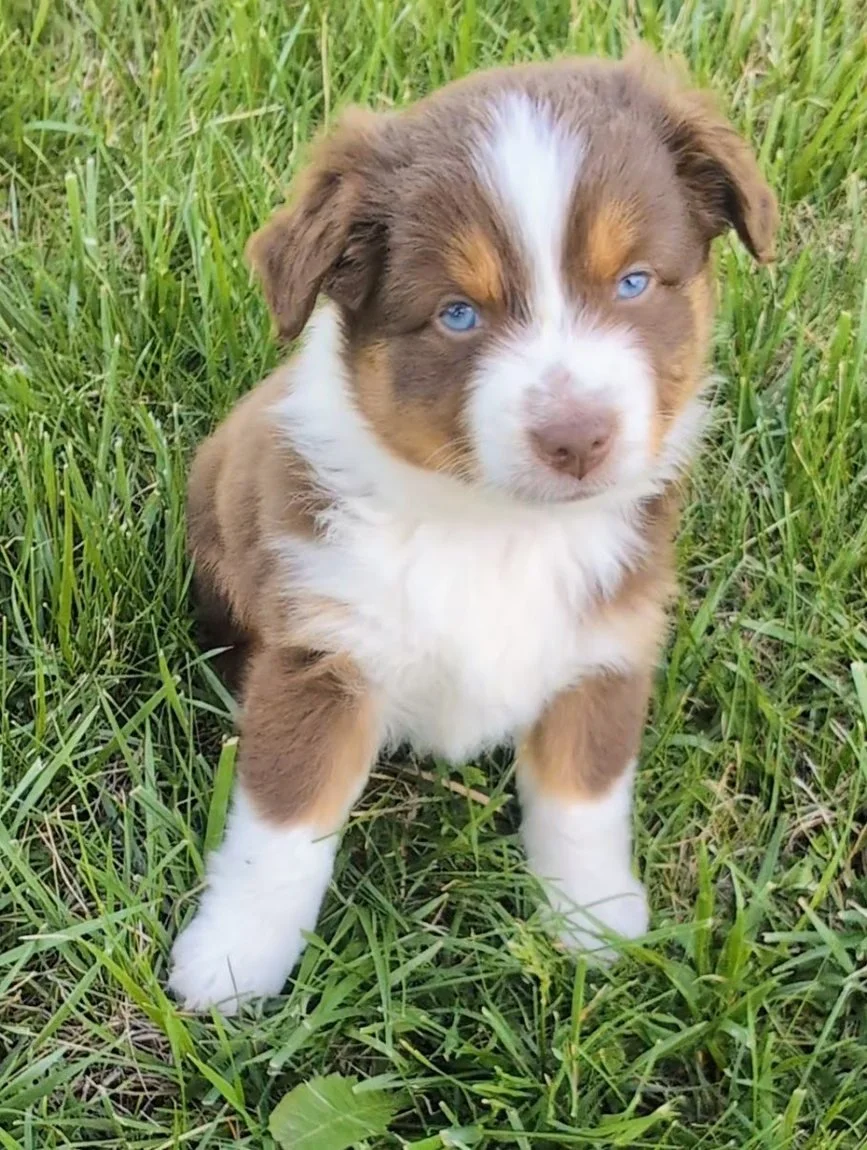
Bringing Home a Mini Aussie Puppy: Miniature American Shepherd First-Week Guide
Bringing home a Mini Aussie or Miniature American Shepherd puppy? Learn about the first night, potty training, biting, crates, sleep, socialization and training.
Bringing home a Mini Aussie puppy is exciting, but those first few weeks can also leave you wondering whether you brought home an adorable fluffy puppy or a tiny, highly intelligent velociraptor.
Miniature American Shepherds—commonly called Mini Aussies—are intelligent, observant herding dogs that tend to learn very quickly. That can make them incredibly fun to train, but it also means they are constantly learning from the environment around them, whether you intended to teach them something or not.
At Trailside Mini Aussies & Aussiechons in Missouri, our puppies are raised with an emphasis on early socialization, enrichment, handling, and positive-reinforcement foundations. One of the biggest things I want new puppy owners to understand is that the first few weeks aren't about creating a perfectly obedient dog.
They're about building a foundation.
Whether you're preparing to bring home a Mini Aussie puppy, have recently welcomed a Miniature American Shepherd into your family, or are researching whether this breed is right for you, here's what I would prioritize during your puppy's first weeks at home.
Before Your Mini Aussie Puppy Comes Home
You don't need to turn your house into a pet store before pickup day, but you should have a basic management plan.
Decide where your puppy will sleep, where they will potty, where they can safely spend time when you aren't actively supervising them, and which parts of your house will initially be off-limits.
An appropriately sized crate, puppy pen or puppy-proofed area, baby gates, safe chews, food-stuffable toys, leash, collar or harness, treats, grooming supplies, and enzymatic cleaner will make the transition much easier.
And don't feel guilty about restricting your puppy's freedom.
A young puppy doesn't need access to the entire house.
If your puppy can't sneak behind the couch to potty, steal laundry from three bedrooms, or spend twenty minutes chewing the corner of a rug, you don't have to train those behaviors away later.
Good puppy management makes the right choices easier.
As your Mini Aussie develops better potty habits, household manners, and the ability to settle, their freedom can gradually increase.
The First 72 Hours With Your Mini Aussie Puppy
Coming home is already a huge socialization experience.
Your puppy has left the environment they knew. Their littermates are gone. Their routine has changed. The smells, sounds, people, sleeping arrangements, and expectations are all different.
You don't need to compensate by introducing your puppy to everyone you know during their first weekend.
Keep life relatively simple.
Let your puppy eat, sleep, potty, play, explore, and begin learning who you are.
Some Mini Aussie puppies confidently march into their new house as though they've always lived there. Others may initially be quieter, clingier, hesitant, restless, or less interested in food.
Give your individual puppy time.
And spend those first few days observing.
How does your puppy tell you they need to potty?
What makes them excited?
What helps them settle?
How do they respond when something surprises them?
What kind of play do they enjoy?
You're learning their language while they're beginning to learn yours.
How Much Sleep Does a Mini Aussie Puppy Need?
Miniature American Shepherds are active dogs, which sometimes leads owners to assume that every undesirable puppy behavior means their puppy needs more exercise.
Sometimes the exact opposite is true.
Young puppies need a tremendous amount of sleep and downtime. An overtired puppy doesn't always curl up and peacefully fall asleep.
Sometimes they become completely unhinged.
An overtired Mini Aussie puppy may start running through the house, grabbing clothes, biting increasingly hard, barking, attacking the leash, chasing feet, and becoming seemingly incapable of making a good decision.
Before adding another game of fetch, consider whether your puppy needs to potty and go to sleep.
A useful puppy rhythm is:
WAKE → POTTY → EAT / PLAY / TRAIN → POTTY → REST
You don't need to entertain your Mini Aussie every moment they're awake.
In fact, teaching an intelligent, active dog that nothing is happening right now and that's okay can become one of the most valuable skills you teach.
Why Does My Mini Aussie Puppy Bite My Ankles?
Welcome to life with a herding puppy.
All puppies use their mouths. They play with their mouths, explore with their mouths, and go through teething.
Mini Aussies and other herding breeds can add another component: movement can be extremely interesting.
Running children, moving ankles, swinging pant legs, and fast-moving humans can encourage chasing and grabbing.
That doesn't mean every instance of Mini Aussie puppy biting is herding behavior, nor does it mean you need to punish your puppy for expressing normal behavior.
Instead, first ask:
Why is my puppy biting right now?
If your puppy is trying to initiate play with your hands or clothing, redirect the interaction onto an appropriate toy.
If biting becomes increasingly frantic after your puppy has been awake for a long time, consider a potty break and nap.
If your puppy bites during handling, stop and consider whether they're communicating discomfort.
If movement consistently triggers chasing and grabbing, provide appropriate opportunities for movement-oriented play while also reinforcing disengagement from humans.
Tug, retrieving, toy-chasing games, and appropriately managed flirt-pole play can provide outlets for dogs that love chasing movement.
The goal isn't to exhaust your Mini Aussie until they physically can't nip anymore.
We're teaching:
Chasing and biting toys can be fun. Human ankles aren't toys. And excitement can turn back off.
Potty Training a Mini Aussie Puppy
Potty training is primarily a management problem, not an obedience problem.
Your Mini Aussie puppy isn't peeing on your rug because they're stubborn, dominant, mad at you, or getting revenge.
They're a baby learning an entirely new bathroom system.
Take your puppy outside frequently, especially after waking, eating, drinking, active play, and coming out of their crate or pen.
Go outside with them so you know whether they actually went.
When your puppy eliminates outside, reinforce them after they finish.
If there's an accident indoors, skip punishment.
Clean it thoroughly with an enzymatic cleaner and ask yourself what management step you missed.
Did puppy have too much freedom?
Was the potty interval too long?
Did excitement change their normal schedule?
Did you miss their signals?
Adjust the system.
Crate Training Your Mini Aussie Puppy
I want a puppy's crate to predict safety and rest, not suddenly discovering they're trapped and alone.
Start by creating positive associations with the crate.
Feed meals inside. Toss treats into it. Offer special chews or food toys there. Reinforce your puppy for voluntarily walking inside.
Initially, you don't even need to shut the door.
Gradually build comfortable duration before expecting long periods of confinement.
And remember that crate training and alone-time training aren't exactly the same thing.
Your Mini Aussie may happily sleep in their crate while you're nearby and still struggle when you leave the room.
Build separation gradually, too.
Socializing a Miniature American Shepherd Puppy
Socialization is one of the most important parts of raising a Mini Aussie—and also one of the most misunderstood.
Socialization does not mean your puppy needs to meet every person or play with every dog.
Your Miniature American Shepherd doesn't need to become a social butterfly.
In fact, learning to calmly notice another person, dog, bicycle, child, shopping cart, or unusual sound and then continue with life is an incredibly valuable skill.
I care less about how many experiences you can check off a socialization list and more about:
What is your puppy learning from the experience?
Can they observe something unusual?
Can they investigate?
Can they move away?
Can they check in with you?
Can they recover when something startles them?
Your puppy doesn't have to love everything.
Positive is good. Neutral is good. Overwhelmed isn't the goal.
What Should You Do When Your Mini Aussie Puppy Is Afraid?
Mini Aussies can be observant dogs.
Your puppy may notice environmental changes you barely registered.
If they become unsure about something, resist the urge to drag them closer or lure them right up to it with food.
Give them room to think.
Your puppy might approach, retreat, sniff, look at you, and approach again.
That's information gathering.
Retreat isn't failure.
If your puppy needs additional distance to comfortably observe something, give it to them.
Confidence doesn't mean never experiencing fear.
A confident dog can encounter something unexpected, gather information, recover, and continue with life.
That's what we're trying to build.
Start Grooming and Handling Your Mini Aussie Early
That beautiful Mini Aussie coat comes with maintenance.
Don't wait until you desperately need to trim a nail, remove a knot, or examine an ear to introduce handling.
Start with tiny exercises.
Touch a paw, then reinforce.
Briefly hold the paw, then reinforce.
Touch a nail with the nail tool, then reinforce.
Brush once, then reinforce.
Look inside an ear, then reinforce.
You don't need to perform an entire grooming session every time.
You're building a long-term emotional response to handling.
Whenever possible, I don't simply want a dog who tolerates care.
I want a dog who understands what's happening and can comfortably participate.
What Should I Teach My Mini Aussie Puppy First?
Miniature American Shepherds are fantastic learners, and it's tempting to immediately start teaching everything.
Sit and down are perfectly useful.
But they're not necessarily my highest priorities.
I'd rather establish a strong name response, voluntary check-ins, recall, trading and dropping objects, hand targeting, leash foundations, handling, settling, crate comfort, and short periods of comfortable independence.
Most importantly:
Teach your puppy that learning with you is fun.
You have years to teach behaviors.
The relationship your puppy develops with training itself will influence everything you teach afterward.
Your Mini Aussie Puppy's First Month at Home
During the first three days, prioritize safety, sleep, potty routines, meals, and helping your puppy understand their new environment.
During days four through seven, begin tiny training sessions, crate games, handling, check-ins, recall games, trading, and manageable periods of independence.
During week two, continue expanding your puppy's world through thoughtful, safe socialization. Introduce different environments, people, surfaces, sounds, appropriate dogs, car rides, and everyday experiences without overwhelming them.
During weeks three and four, continue those experiences while building practical skills such as leash walking, settling, recall, grooming, alone time, and calm behavior around distractions.
You don't need to accomplish everything in four weeks.
You're establishing a foundation you'll continue building throughout your dog's life.
Want a Step-by-Step Plan for Bringing Your Puppy Home?
I created Bringing Puppy Home: Your Positive-Reinforcement Guide to the First Month Together for exactly this stage of puppyhood.
It's a practical, digestible guide to the questions new puppy owners actually have: potty training, crate training, puppy biting, sleep and the puppy witching hour, socialization, fear and startle, alone time, handling and cooperative care, enrichment, resource guarding prevention, what to train first, and what to prioritize during your first month together.
GET THE BRINGING PUPPY HOME GUIDE
Whether your puppy came from Trailside or somewhere else, the goal is the same:
You aren't trying to create the finished dog in the first month.
You're building the foundation the adult dog will stand on.
Mini Aussie & Miniature American Shepherd Puppy FAQ
Are Mini Aussies and Miniature American Shepherds the same thing?
“Mini Aussie” is a commonly used name associated with small Australian Shepherd-type dogs, while Miniature American Shepherd is the recognized breed name used by the American Kennel Club. If you're researching a breeder or puppy, ask what registry the dogs belong to rather than relying on the terms interchangeably.
Why is my Mini Aussie puppy biting me so much?
Puppies may bite because of play, teething, fatigue, frustration, overstimulation, or discomfort. Herding breeds may also be especially interested in chasing and grabbing movement. Look at what happens immediately before the biting rather than treating every bite as the same problem.
Should my Mini Aussie puppy meet every dog?
No. Socialization isn't about maximizing the number of dogs your puppy meets. Carefully selected positive interactions can be valuable, but your puppy should also learn to calmly observe dogs without expecting to greet or play with them.
When should I start training my Miniature American Shepherd puppy?
Learning begins immediately, but formal sessions don't need to be long. Incorporate very short positive-reinforcement opportunities throughout everyday life. Name response, recall, check-ins, handling, trading, settling, and crate comfort are excellent early priorities.
How do I tire out a Mini Aussie puppy?
Don't make exhaustion the goal. Mini Aussie puppies benefit from an appropriate combination of sleep, exploration, sniffing, play, training, chewing, and age-appropriate physical activity. More exercise isn't always the solution to wild behavior—sometimes an overtired puppy needs rest.
How long does it take a Mini Aussie puppy to adjust to a new home?
There isn't one universal timeline. Some puppies appear comfortable almost immediately, while others need days or longer to fully relax and show their typical personality. Keep routines predictable and allow your puppy to adjust at their own pace.
Where can I find Mini Aussie puppies in Missouri?
Trailside Mini Aussies & Aussiechons is based in Missouri and raises Mini Aussie/Miniature American Shepherd and Aussiechon puppies with an emphasis on thoughtful puppy development, enrichment, socialization, and positive-reinforcement foundations.
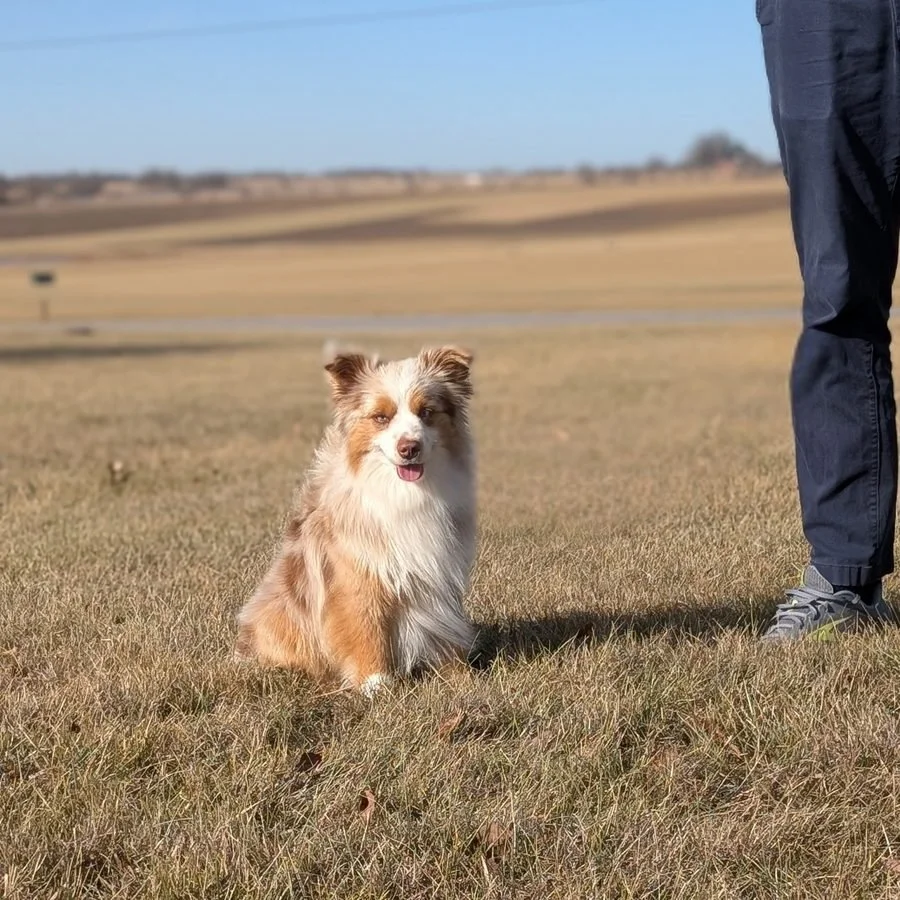
Mini Aussie vs. Miniature American Shepherd: What's the Difference?
Confused about the difference between a Mini Aussie and a Miniature American Shepherd? Learn how they compare in history, size, registration, temperament, and which is the best fit for your family.
If you've been researching these incredible little herding dogs, you've probably noticed something confusing: some breeders advertise "Mini Aussies," while others have "Miniature American Shepherds." Are they actually different breeds? Are they the same dog with different names? And which one is right for your family?
The short answer is they are extremely closely related—but they are not exactly the same thing.
As a breeder, this is one of the questions I answer most often. Understanding the history behind these names will help you make a more informed decision and know exactly what you're looking for when choosing a puppy.
Quick Comparison
Mini AussieMiniature American ShepherdAKC Recognized?Not as a breedYesASDR Registered?YesSome may also be ASDROriginsSelectively bred smaller Australian ShepherdsDeveloped from Mini Aussies and recognized by AKCTypical Size13–18 inches, 20–40 lbs (varies by breeder)13–18 inches, generally 20–40 lbsTemperamentIntelligent, athletic, affectionateIntelligent, athletic, affectionateHerding AbilityExcellentExcellentFamily CompanionExcellentExcellent
Are Mini Aussies and Miniature American Shepherds the Same?
Not exactly—but they're incredibly closely related.
Both trace their roots back to smaller Australian Shepherds that breeders began selectively breeding several decades ago. These smaller dogs became known as Miniature Australian Shepherds, or "Mini Aussies."
As the dogs became more consistent in size and type, a group of breeders pursued recognition through the American Kennel Club (AKC). Because the AKC already recognized the Australian Shepherd as a separate breed, the smaller version could not simply be called a Miniature Australian Shepherd.
Instead, the AKC recognized the breed under a new name:
Miniature American Shepherd.
Today, many dogs still share the same ancestry, and you'll find breeders using either terminology depending on their breeding program and registration.
Why Do Some Breeders Still Say "Mini Aussie"?
There are several reasons.
Many breeders register with organizations like the American Stock Dog Registry (ASDR), where "Miniature Australian Shepherd" remains an accepted designation.
Others use "Mini Aussie" because it's the name most puppy buyers recognize when searching online.
Some breeders—ourselves included—raise dogs that are registered in multiple registries and use both terms to help educate prospective owners.
Regardless of the terminology, it's important to look beyond the name and evaluate the individual breeder, their health testing, puppy raising practices, and goals for their breeding program.
Is There a Difference in Temperament?
For most families, not really.
Both are known for being:
Highly intelligent
Eager to learn
Extremely people-oriented
Loyal
Athletic
Fun-loving
Capable of relaxing with their family after their exercise needs are met
These are dogs that thrive when they're included in everyday life. They enjoy hiking, training, trick work, agility, rally, obedience, scent work, and simply spending time with their people.
At Trailside Mini Aussies, one of our priorities is producing dogs with an excellent "off switch." We love active dogs, but we also value puppies that can settle in the house after a walk, training session, or family adventure.
What About Size?
Both Mini Aussies and Miniature American Shepherds generally fall into a similar size range.
Most adults are:
Height: approximately 13–18 inches
Weight: roughly 20–40 pounds
Individual breeding programs may consistently produce dogs on the smaller or larger end of that spectrum.
For example, our breeding program focuses on producing compact, athletic companions that fit comfortably into active family life while still retaining the structure and versatility that make these dogs so enjoyable.
Understanding Toy vs. Mini Size
One point that often causes confusion is the difference between toy and mini sized dogs.
The American Kennel Club (AKC) recognizes only one size for the Miniature American Shepherd. According to the AKC breed standard, dogs should measure:
Males: 14–18 inches at the shoulder
Females: 13–17 inches at the shoulder
Dogs outside of these height ranges may not meet the AKC breed standard, even if they otherwise resemble a Miniature American Shepherd.
In contrast, many breeders who register with organizations such as the American Stock Dog Registry (ASDR) use additional size categories, including Toy, Mini, and Standard, based primarily on height. While exact classifications may vary by registry, "Toy" generally refers to dogs that are smaller than the typical Miniature American Shepherd standard.
It's important to understand that "Toy Mini Aussie" is not a separate breed. Instead, it's a descriptive term used by some breeders and registries for particularly small Miniature Australian Shepherds.
At Trailside Mini Aussies, we occasionally produce puppies that mature on the smaller end of the spectrum because our stud dog is approximately 11 pounds, while our females are in the miniature size range. As a result, our puppies often mature into larger toy or smaller miniature adults. Rather than breeding solely for the smallest possible size, our priority is producing dogs with excellent health, sound structure, stable temperaments, and the versatility to thrive as family companions, adventure partners, and dog sport competitors.
For most families, a difference of a few inches or pounds has far less impact on daily life than temperament, health, and how a puppy was raised. Choosing a breeder who prioritizes these qualities is typically much more important than selecting a puppy based solely on whether it is labeled "toy" or "mini."
Are They Good Family Dogs?
In the right home, absolutely.
Miniature American Shepherds and Mini Aussies tend to do wonderfully with families who enjoy spending time with their dog.
They typically excel when given:
Daily walks
Opportunities to learn
Positive reinforcement training
Interactive toys
Time with their family
They're often affectionate, playful, and eager to participate in whatever their people are doing.
However, because they're herding dogs, they generally aren't couch potatoes. Mental enrichment is just as important as physical exercise.
Are They Easy to Train?
One of the biggest reasons people fall in love with these dogs is their incredible trainability.
Their intelligence allows them to learn quickly, but it also means they notice patterns—and inconsistencies.
We raise our puppies using positive reinforcement, early enrichment, and structured socialization because these experiences help build confident learners who enjoy training.
Many Miniature American Shepherds excel in:
Agility
Rally
Obedience
Trick training
Disc dog
Nose work
Therapy work
Service dog tasks
Herding
Even if you never compete, they're wonderful companions for families who enjoy teaching fun behaviors and involving their dog in everyday life.
Which Registration Matters?
Registration organizations serve different purposes.
The AKC recognizes the Miniature American Shepherd as an official breed.
The ASDR continues to register many Miniature Australian Shepherds.
Registration tells you about pedigree and record-keeping, but it shouldn't be the only factor you consider.
Equally important are:
Health testing
Temperament
Ethical breeding practices
Puppy socialization
Lifetime breeder support
How Do I Choose a Good Breeder?
Instead of focusing only on whether a breeder says "Mini Aussie" or "Miniature American Shepherd," ask questions like:
Are the parents health tested?
What temperament are they selecting for?
How are puppies raised?
What early socialization is provided?
What support do they offer after puppies go home?
Can they explain why they made this particular breeding?
These questions will tell you much more about your future puppy than the name alone.
Which One Is Right for You?
For most families, the answer isn't choosing between a Mini Aussie and a Miniature American Shepherd—it's choosing the right breeder and the right individual puppy.
Whether your puppy is described as a Mini Aussie or a Miniature American Shepherd, you're likely getting an intelligent, affectionate, athletic companion capable of excelling in family life, adventures, and dog sports.
The best breeders prioritize health, temperament, thoughtful puppy raising, and lifelong support, helping you find a puppy that's a great match for your lifestyle.
Frequently Asked Questions
Is a Miniature American Shepherd the same as a Mini Aussie?
They're closely related and share the same origins, but "Miniature American Shepherd" is the official AKC breed name, while "Mini Aussie" is still commonly used by breeders and owners.
Are Miniature American Shepherds recognized by the AKC?
Yes. The Miniature American Shepherd is fully recognized by the American Kennel Club.
Do Mini Aussies shed?
Yes. They have a double coat and shed year-round, with heavier seasonal shedding in the spring and fall. Regular brushing helps keep shedding manageable.
Are Miniature American Shepherds good with children?
Most are excellent family dogs when well-bred, properly socialized, and supervised around young children. They typically enjoy being involved in family activities and often form strong bonds with their people.
Are Mini Aussies good for first-time dog owners?
They can be, provided their owners are prepared to meet their needs for exercise, enrichment, and ongoing training. Their intelligence makes them rewarding companions, but they thrive with consistency and positive reinforcement.
Interested in learning more? If you're still deciding which type of puppy fits your family best, our Mini Aussie vs. Aussiechon Quiz can help you compare personalities, grooming needs, and lifestyle fit. You can also explore our current and planned litters or reach out if you'd like help choosing the right puppy for your family.
https://www.honeybook.com/widget/trailside_mini_aussies_296101/cf_id/69a605642729d4002314af59
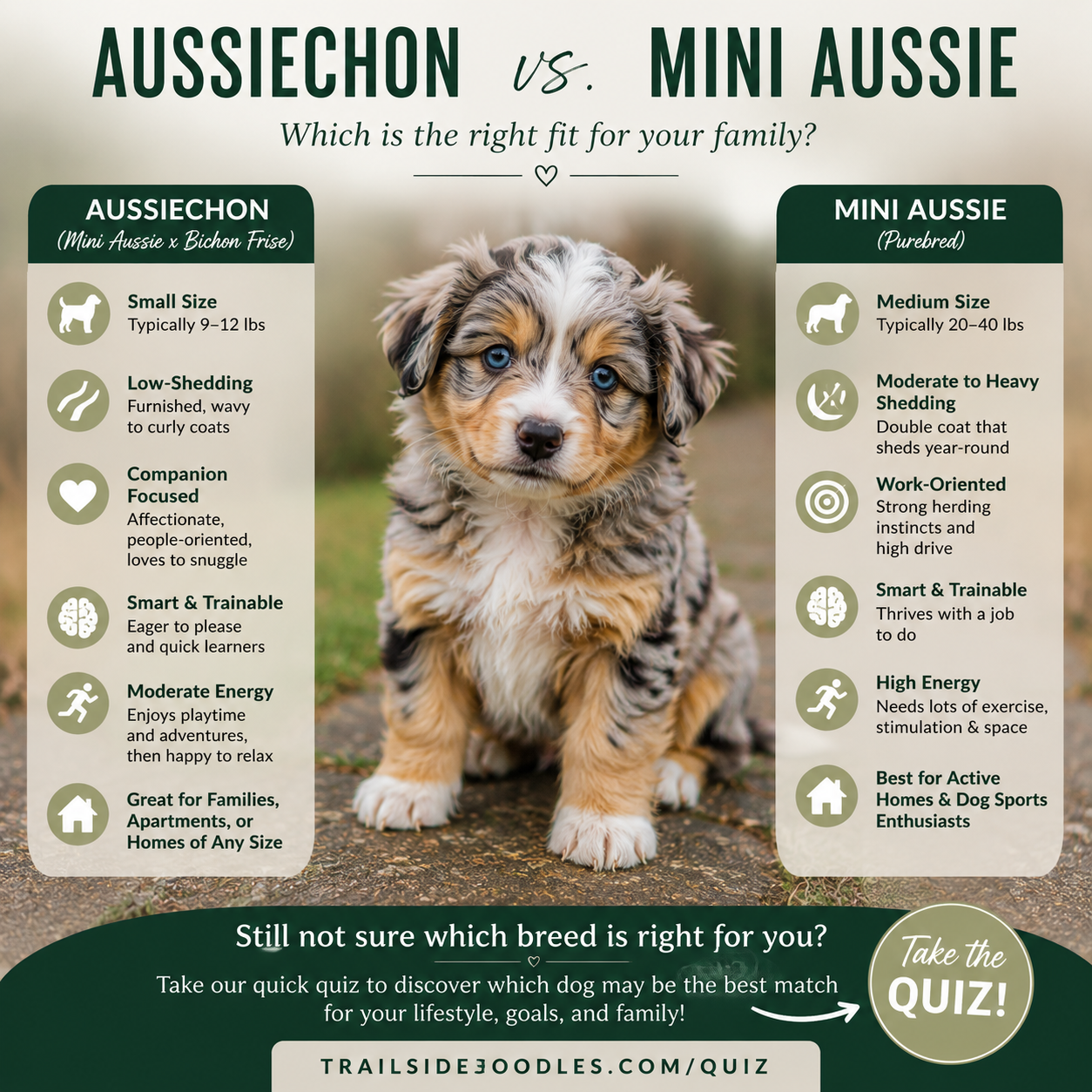
Aussiechon vs. Mini Aussie: Which Dog Is Right for Your Family?
Aussiechon or Mini Aussie? Learn the biggest differences in shedding, temperament, exercise, and family life—and take our free quiz to discover your perfect match.
If you're looking for an intelligent, affectionate, family-friendly dog, you've probably come across two breeds that seem to check all the boxes: the Mini Aussie (Miniature American Shepherd) and the Aussiechon.
At first glance, they may appear surprisingly similar. Both are playful, people-oriented, and thrive as companions. But they differ in important ways—including energy level, grooming, shedding, trainability, and the type of lifestyle they're best suited for.
As someone who raises both Miniature American Shepherds and Aussiechons, I love both breeds—but for different reasons. Neither is "better." The best choice depends entirely on what you're looking for in a dog.
This guide will walk you through the similarities and differences so you can confidently choose the breed that best fits your family.
Quick Comparison
FeatureAussiechonMini Aussie (Miniature American Shepherd)Size12–20 lbs (varies by generation)20–40 lbsSheddingLow to minimalModerate year-roundGroomingProfessional grooming every 6–8 weeksRegular brushingEnergy LevelModerateModerate to HighTrainabilityExcellentExcellentAthletic AbilityModerateExcellentDog SportsFun recreationallyExcels competitivelyGood with KidsExcellentExcellentFirst-Time OwnersExcellentGood with commitmentCuddle Factor⭐⭐⭐⭐⭐⭐⭐⭐⭐☆Outdoor Adventure⭐⭐⭐⭐☆⭐⭐⭐⭐⭐
Meet the Miniature American Shepherd
The Miniature American Shepherd (often called a Mini Aussie) was developed from smaller Australian Shepherds to create a compact herding dog without sacrificing intelligence or athleticism.
These dogs were bred to work alongside people. They are eager to learn, incredibly versatile, and capable of excelling in nearly any activity you introduce them to—from hiking and agility to therapy work and advanced trick training.
One of the things I love most about this breed is their enthusiasm for learning. They genuinely enjoy having a job and tend to build deep relationships with their families.
They're often described as "Velcro dogs" because they want to be wherever you are.
Meet the Aussiechon
The Aussiechon is a cross between a Miniature American Shepherd (or Mini Aussie) and a Bichon Frise.
The goal is to combine many of the qualities people love about Mini Aussies—intelligence, trainability, and affectionate personalities—with the lower-shedding coat and easygoing nature of the Bichon Frise.
Our long-term goal at Trailside is to produce dogs that are:
Friendly and social
Highly trainable
Wonderful family companions
Lower shedding
Adaptable to many lifestyles
Confident and resilient
Athletic enough for adventures while happy to curl up on the couch afterward
Because Aussiechons are a mixed breed, individual puppies can vary more than a purebred Miniature American Shepherd. Some inherit more Aussie traits, while others take after the Bichon side.
Temperament
Miniature American Shepherd
These dogs are incredibly intelligent.
They notice routines.
They anticipate patterns.
They often seem to understand what you're asking before you've finished asking it.
That intelligence makes them wonderful companions—but it also means they need mental stimulation.
Many Miniature American Shepherds love:
Trick training
Agility
Rally
Hiking
Frisbee
Nose work
Herding
Learning new skills
They're happiest when they feel included in family life.
Aussiechon
Aussiechons often retain the intelligence of the Mini Aussie while adding a little more of the Bichon's easygoing attitude.
Many families describe them as:
Silly
Happy
Social
Cuddly
Adaptable
People-oriented
While they still enjoy learning and enrichment, they often don't have quite the same drive for constant activity as many Miniature American Shepherds.
For families looking for an intelligent companion without quite as much intensity, this can be a wonderful balance.
Energy Level
One of the biggest misconceptions about Mini Aussies is that they need to run for hours every day.
In reality, mental exercise is just as important as physical exercise.
Training sessions, puzzle toys, scent games, and opportunities to learn often tire these dogs out more effectively than endless games of fetch.
That said, they generally enjoy a more active lifestyle than the average companion breed.
Aussiechons also enjoy walks, playtime, enrichment, and adventures—but many are content with slightly less daily activity and settle more easily afterward.
If your ideal weekend includes hiking, camping, or dog sports, the Miniature American Shepherd may be your perfect match.
If your ideal weekend includes neighborhood walks, trips to the park, coffee shops, and movie nights on the couch, the Aussiechon may be the better fit.
Shedding & Grooming
This is where the two breeds differ the most.
Miniature American Shepherd
Miniature American Shepherds have a beautiful double coat that sheds throughout the year, with heavier seasonal shedding in the spring and fall.
Routine brushing helps remove loose hair and keeps the coat healthy.
Most owners find brushing once or twice a week sufficient, with more frequent brushing during seasonal coat changes.
Professional grooming is optional but can be helpful for nail trims, bathing, and tidying feathering.
Aussiechon
Many families are drawn to Aussiechons because they typically shed much less than a Miniature American Shepherd.
However, lower shedding comes with a tradeoff.
Instead of shedding their coat onto your furniture, much of the hair remains trapped within the coat and requires regular brushing and professional grooming.
Most Aussiechons benefit from:
Brushing several times each week
Professional grooming every 6–8 weeks
Regular ear care
Routine nail trims
If you're looking for a dog with less hair around the house and are comfortable scheduling grooming appointments, an Aussiechon may be an excellent choice.
Which Breed Is Easier to Train?
Both breeds are highly trainable.
At Trailside, we begin introducing puppies to learning from an early age using positive reinforcement, age-appropriate enrichment, and gentle exposure to new experiences.
Miniature American Shepherds often have a stronger desire to solve problems and work through complex training challenges.
Aussiechons are also quick learners, but many are a bit more laid back and may be especially appealing to families looking for an enthusiastic companion without the same level of working-drive.
For both breeds, we strongly recommend positive reinforcement training. It builds confidence, strengthens your relationship, and makes learning enjoyable for both you and your puppy.
Still Deciding?
Choosing a puppy is about much more than picking the cutest face—it's about finding a companion whose personality, energy level, grooming needs, and lifestyle are the right fit for your family.
Whether you choose a Miniature American Shepherd or an Aussiechon, you'll be bringing home a dog that can become an incredible lifelong companion when thoughtfully bred, well-socialized, and raised with positive reinforcement.
If you're still unsure which breed is the better match, we've created a free Mini Aussie vs. Aussiechon Quiz to help. Based on your answers, we'll recommend the breed that best fits your family and explain why.
CLICK HERE TO START THE QUIZ
After taking the quiz, you're welcome to explore our current and planned litters, join our waitlist, or reach out with any questions. We love helping families find not just a puppy—but the right puppy.